by Barbara | Dec 16, 2019 | Blog
by Nikki Biskis and Barbara Wueringer
We are excited to announce that a long imagined SARA initiative is well underway! Since commencing our public submissions campaign in 2016, we have received over 140 sawfish saws in donation. Some of the saws are used for school visits and species ID workshops, but we are now on a mission to display the majority of saws all over Far North Queensland. This is our chance to turn saws once removed as trophies into messengers for conservation!
Right now we are designing and building informative displays to educate communities about how to safely release sawfish from fishing gear and report sightings to us. Our conversations with people from all walks of life have shown that once people understand how threatened sawfish are, they become stewards for these amazing animals. Ensuring that the saw is not amputated from an accidentally captured sawfish is one of our priorities.
So far we have received funding from the Advanced Queensland Citizen Science Initiative for the first 25 locations, with an ultimate goal of reaching 50. SARA has also received overwhelmingly positive feedback from the locations contacted so far. We have officially picked the first 20 locations, and most of them are already on board! Thank you to everyone that offered to be a part of our mission! If you think that your location (iconic pub, road house, tourist info centre and more) sees large numbers of both tourists and local visitors, and would like to join this project, please send an email to nikki(at)saw.fish
Both the Sawfish Biology Guide and Display Flyer were designed with this project in mind
Currently planned locations for sawfish saw displays: Albatross Bay Resort (Weipa), Daintree Discovery Centre (Daintree), Barramundi Discovery Centre (Karumba), Cape York Peninsula Lodge (Bamaga), Lakeland Hotel (Lakeland), Moreton Telegraph Station (-12.4536°, 142.6386°), Cardwell Rainforest and Reef Visitor Information Centre, Cairns Aquarium, Normanton Library/Info Centre, Kowanyama Ranger Office, Kowanyama PCB, Nature’s Powerhouse (Cooktown Visitor Information), Hann River Roadhouse (-15.1889°, 143.8725°), Palmer River Roadhouse (-16.1070°, 144.7769°), Archer River Roadhouse (-13.4376°, 142.94168°).

by Barbara | Dec 10, 2019 | Blog
by Nikki Biskis
In September 2018, SARA received what is probably the cutest scientific interview of all time. Billy, Charlie, Dylan and Jayden of Birmingham Primary School in Mount Evelyn, VIC, had some very creative questions regarding sharks and rays. So, naturally, four lucky biologists from the SARA team responded right back to these curious minds. Some of our favourites are below!
- Do some sharks fight?
Sharks do not really fight very often but bigger sharks do scare off smaller sharks. If two sharks are swimming straight towards each other the smaller shark is the one that will move out of the way to let the big one carry on swimming. Big sharks can also eat small sharks!
- Do sharks mean to eat people?
No! Unlike humans, sharks don’t have any hands, so they can’t pick things up to figure out what they are. Instead they take a bite. Only once they take a taste of something can they be sure of what it is. Humans are not on the normal menu for sharks. So usually once they taste us they don’t want another bite.
- Do sharks smell oil?
Sharks have an incredible sense of smell, so it is very likely they can smell oil. Nearly two thirds of a shark’s brain is for thinking about smells and they can sniff out just one teaspoon of fish blood from a swimming pool sized area of water.


by Barbara | Nov 17, 2019 | Blog
Since 2015, Sharks And Rays Australia is working with sawfish in Queensland. They are globally critically endangered. We spend about 3 months in the field every year, sampling for these animals in some of the most remote sites in Australia. On every field trip we visit a remote school, and when possible we work with the local Indigenous Land and Sea Rangers to increase their knowledge on sawfish and how to look after these animals. We also work with commercial fishermen to create a sustainable model of conservation that also maintains healthy fisheries.
In July 2019, we had a car accident on our way to our field site. Luckily nobody was injured but our amazing expedition vehicle, a Landcruiser Troopcarrier, was destroyed. While the insurance has paid out what they consider the market value to be, it does not even cover half of the cost of a replacement car, let alone fitting out the car to be field ready.
Please help us! Anything counts towards our goal – so remember, no donation is too small!
If you are a sawfish hero or business, from a donation of A$ 750 onwards we will add your sticker on the back of our expedition vehicle, for all of remote Queensland to see. For donations above A$ 3000 you will be allowed to name one of our satellite tagged sawfish and receive a certificate and 3 updates on its whereabouts. For donations of or above A$ 5000 you will be mentioned as a sponsor on our homepage for 2020! If you are representing a business please contact Barbara@saw.fishto check that our values align.
Thanks so much everybody, together we can make a difference!
Please find our Go Fund Me campaign here https://www.gofundme.com/f/83kgqv-help-sawfish-research-team-get-back-on-the-road
by Barbara | Nov 15, 2019 | Blog
By Veronika Biskis
Sawfish populations are receding to some of the most remote areas in northern Queensland. SARA works with sawfish in Queensland on a large geographic scale, and we are fortunate to have incredible partners that dedicate both time and money in conducting these surveys. In addition, crucial information comes from submissions from past and present fishers and their families. With sawfish becoming quite rare, these reports from citizen scientists are an important part of our assessment of sawfish range and distribution.
But what actually happens when a sawfish is caught in a commercial gill net? It is one thing to set one with the specific purpose of research – the team is trained in sawfish release and are prepared for the next steps. This is a different scenario when they wind up as by-catch. While sawfish are not readily seen to the sizes reported back in the 70s and 80s, animals around the 5m mark are still occasionally caught. Fishers report they thrash wildly, often becoming further and further ensnared. Evidence has shown that sawfish can last for hours in a net as long as it isn’t wrapped around their gills. However, once they are taken out of the water for removal they suffocate – hence their understandably severe reaction. How can commercial fishers release a sawfish in a matter of seconds, without causing injury to themselves, the net, and the sawfish?
Karumba is a small fishing town situated where the Norman river meets the Gulf of Carpentaria, truly the ‘outback by the sea.’ It is also the meeting place of the annual meeting of the Gulf of Carpentaria Commercial Fishermen Association Inc., which SARA was invited to attend this October. As the accidental by-catch and safe release of sawfish is likely the most dangerous occupational hazard for commercial gill netters, SARA held a unique contest asking fishers to showcase their handling skills. We got a first-hand look at how sawfish are removed from the net on the job.

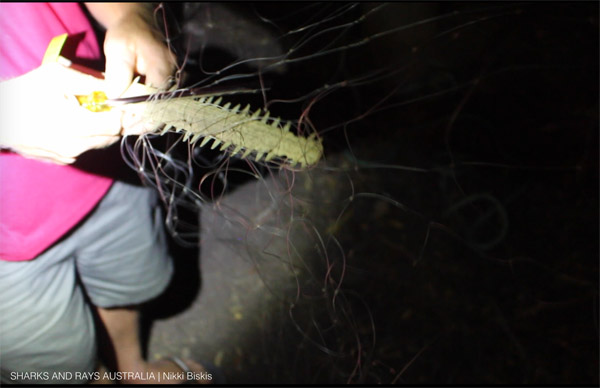
Anoxypristis saw entangled in a gill net, at the start of experimental trial. Image by Nikki Biskis, SARA
Our experiment yielded some exciting preliminary results:
- Releasing sawfish is like riding a bicycle! The longest career fishers were able to remove saws the fastest, even if the fishers had been out of the game for over 10 years.
- Every top competitor used a different removal tool, ranging from various types of barra-hooks to a screwdriver.
- Skills are passed down from families and former skippers. Deck hands on the same boat tended to use the same tools.
- The fastest time of release was 39 seconds!

There are not many places in Queensland where you can see a sunset over the sea, and Karumba is one of them. Image by Nikki Biskis, SARA
Through conversations with fishers we learned that many employ tonic immobility, where they flip the sawfish on their back to calm them. Many fishers had learned this on the job, and did not know that this technique had a name. All had amazing stories to tell of their experiences with sawfish – for example, some talked about seeing them hunt first hand. This behaviour in the wild has never been captured on video.
This is a first step in our initiative to develop materials to help train future fishers in the proper release of sawfish in the wild. In addition, it reiterates the importance of commercial fishers as sawfish advocates, potentially holding the key to their survival. Who better to safely tag and release sawfish than those who regularly handle them? Thirty years ago, this contest may well have been met with laughter – why not just shoot it? But nowadays, with fishers still active, who have seen sawfish numbers drop over the last decades, we can all work together to develop fishing practises to better protect the waterways and the crucial species living in it.
This project is funded by the Shark Conservation Fund.

by Barbara | Oct 21, 2019 | Blog
In Australia, we have a responsibility to look after our four species of sawfish. Sawfish are the most endangered of all sharks and rays globally. Northern Australia is the last global stronghold for four out of five species.
For this year’s International Sawfish Day, some major media outlets became interested in Australian sawfish. These animals are receiving a lot of media attention recently, and with this comes a network of opinions and agendas. Because of these two recent articles on ABC and in the Guardian Australia, which present and also intermingle a lot of different view points, I would like to elucidate the direction of Sharks And Rays Australia in this field.
For the last 5 years, under my lead, SARA has worked with sawfish in Far North Queensland, the Gulf of Carpentaria and the Cape York Peninsula. Our philosophy for sawfish research and conservation is that ‘it takes more than a village’ to bring sawfish numbers back and we need everyone involved. Now, if you are one of the fishers who say that you still see plenty of them, I might ask you to take a look at our species ID flyer. Right now, we are mainly concerned with the three Pristis species, which take 8-10 years to become sexually mature. Anoxypristis (narrow sawfish, slimy’s) mature after 3 years and are thus still found in higher numbers. But even Anoxypristis is in trouble. In 2016 we found fins from this species on a drying rack in the Gulf of Carpentaria, and in 2018 we had a sighting of a sawless individual from the east coast submitted to us. If you regularly see large numbers of the other species, please report them to us!
In Australia, sawfish are federally protected on the EPBC Act and in Queensland they are also protected under the Fisheries Act, which means that from a legislative perspective, they are well covered. But once you spend time in remote regions, talking and working with station managers, Indigenous Rangers and fishermen, a whole different picture emerges. Everyone has a story to tell, of how they used to catch ‘really big ones’, but haven’t seen a single animal in 10-15 years. And everyone has someone else to blame for this.
The reality is that every single person who took a sawfish saw as a trophy contributed to the species’ declines. But while pointing the finger only creates scapegoats, anger and an outlet, it does not help sawfish. These animals continue to fall through the cracks. Instead of judging the past it is more helpful to take responsibility and change the future.
And in this, everyone has a role to play:
- Our regular visits to schools have led to the collaborative development of materials. The Normanton State School has taken the life cycle up in its curriculum, and last time we visited they baked a sawfish shaped cake. Love your work!
- We also work with commercial fishers. So far, I have only collaborated with a handful of fishers, but these guys are now putting tags on sawfish for us and releasing them alive. They are happy to go out of their way to release a 4m sawfish, even when working by themselves. Needless to say, this can be very dangerous as sawfish use their saw to defend themselves and such a large animal can hurt people.
- We are always on the hunt for sawfish sighting submissions from the general public and recreational fishers. The old records that you have at home are important for sawfish conservation. We do not judge people who are in the possession of old saws, it is pretty clear that everyone used to take them as trophies. But it is important that this practise stops, as most animals will not survive this illegal procedure and their saw is much more important then as a dust collector. Your sawfish sighting submissions have already allowed us to show that the historic range of freshwater sawfish was larger than previously assumed, as they occurred near Brisbane.
- Our field assistants are not shy to join us on our field trips and do the hard work. Working in remote regions, without the daily pleasantries of hot showers, air condition and high speed internet, and contributing financially to make those expeditions happen, these young adults are my heros. They might disappear back into a different world after the expedition, but they now understand what’s at stake.
- We also work with Indigenous Land and Sea Ranger groups. With every group we have different agreements, and some are more hands-on in helping us than others. But all of them matter, and sawfish matter to them, as you can see in this blog post.
- We also work with the public aquarium industry, who have sponsored some of our tags and are spreading the word for sawfish through their educational displays.
What about net free zones? Shall we close down all gill net fisheries? I personally think that net-free zones are only a solution in close vicinity of towns with large recreational fishing communities, and active fisheries enforcement. Closing down fisheries is not a solution, as it only exports the problem. Gill nets are used everywhere around the world, and in Australia we can document and invent methods of making these fisheries sustainable when it comes to sawfish by-catch.
In the remote areas that we work in, the displacement of fishers would mean that huge stretches of coastline will receive minimal attention in terms of patrolling and enforcement. The coastline of the Queensland Gulf of Carpentaria alone is about 1200 km long. This could create an open field for foreign fishing vessels, with no quotas or indications of catch and by-catch sizes or management strategies.
The area we work in covers about 2/3 the size of Germany, but it is only inhabited by 28,000 people. Germany, on the other hand, is inhabited by over 82 million people. In such remote areas, it is easy for foreign vessels to enter Australian waters undetected. Remember the vessel full of illegal immigrants that arrived in the Daintree, north of Cairns? This vessel crossed at least 800 km of Australian waters undetected before reaching the coastline.
The Australian fishermen and fisherwomen that I have met have an understanding of how their work changes the environment they work in. They are protective of their industry, that’s for sure, but they are also willing to adopt release practises that are safe and cause minimal harm to the animals. Many of them have developed great methods to release sawfish unharmed, and one of our ongoing projects is to document these methods, with the aim of making them available to every fisher. Without their help, the task of collecting data on Queensland’s sawfish populations is almost impossible. However, individuals who kill sawfish, like the recent deaths in Wujunga or this fisher, who was later found in possession of 63 illegal saws, can give a whole fishery a bad name.
My paper on the sawfish by-catches in the Queensland Shark Control Program indicates that sawfish survive the initial capture in a gill net. Anybody who has caught sawfish in this way, including myself, can confirm that as long as the animals’ gills are not wrapped up they can survive the capture. The key threatening process for sawfish is thus not the capture but the release. It is imperative for the survival of these species, that the animals are released alive, quickly and with minimal damage. Many fishers have adopted methods to avoid catching sawfish (like avoiding certain areas in the ecosystems they work in, or checking their nets very often), and many of them are aware of environmental conditions that will increase sawfish captures. These factors need to be documented in order to create best practise standards across fisheries. Ultimately, I would like to see a Sawfish Sustainability Certification for our Australian fisheries that interact with these animals, but this would require large-scale collaborations between governmental agencies, the conservation sector and fisheries.
Please think about how you fit into sawfish conservation and what you can do to protect these animals, instead of pointing the finger at other people. For example, if you live in an Australian city, you could become a sawfish ambassador and visit schools, hold outreach events and bring the memories of these animals back into people’s minds. This is hard work, but it is also more effective than signing a petition or liking a sawfish conservation post. You could also crochet us a sawfish to give to a remote school, or you could join us in the field. We need more sawfish heros.

by Barbara | Oct 20, 2019 | Blog
International Sawfish Day in Cairns, October 2019
By Nikki Biskis
In October 2019, SARA and the Cairns Aquarium teamed up for an International Sawfish Day event in Cairns. Our sampling event was hosted by the Cairns Aquarium. The event notice was sent to 6,000 people and we were ecstatic with the response from the Cairns community. Former fishers and their families brought in specimens of all sizes and species to be DNA sampled, all with incredible stories to tell.

Barbara samples a saw at a local fishing store
This engagement with the community is crucial, as it helps SARA to understand genetic diversity amongst sawfish populations, and how the distribution of sawfish species have changed over time.

Barbara is interviewed by Win News!
What came next was even more exciting – many continued to submit information of their old saws to SARA and the aquarium, prompting another round of local visits across Cairns for samples. Our project is ongoing, and submissions are always appreciated!
As of today, Sharks and Rays Australia has received around 420 submissions, sampled over 200 saws including 140 that were received in donation. It is events and partnerships with the community that make this all possible.

Nikki sampels a saw at a local store
A special thank you to Cairns Aquarium and to everyone who made International Sawfish Day a success!