by Barbara | Aug 19, 2019 | Blog
Once a year, the Cairns Indigenous Art Fair kicks off in Cairns. Indigenous artists from all over Far North Queensland and Cape York come to Cairns to display their arts. The event grows bigger every year and features so many works on sharks and rays that we always try to be in Cairns for CIAF.
This year, Julia, who is our instagram wizard, and myself visited CIAF together. We grabbed some food and sat down in the grass to listen to what was going on at the stage. Various Indigenous leaders from the Cape were talking about how their language and culture was slowly being lost. At some point, one of the elders started to talk about sawfish. He said that they had disappeared from his native waters and that he was from the community of Pormpuraaw. I looked at Julia and said, ‘We need to talk to him!’
After the session we introduced ourselves to Syd Bruce Shortjoe. I told him that we work with sawfish and that we would like to help him protect these animals in the waters of Pormpuraaw. I told him that SARA already works with the Mapoon Land and Sea Rangers as well as the Kowanyama Land and Sea Rangers. As I had heard of recent captures of sawfish from the Pormpuraaw region, I said to him that sawfish still exist in his native waters, but probably in very low numbers. I also gave Syd one of our flyers and a sunnies neoprene strap that has all the information on how people can submit sawfish sightings to us. While Syd was listening, he started stroking the sawfish image on the neoprene strap.
Syd told us that his great grandfathers’ totem is the sawfish. He said that because of this, the sawfish is part of his family and his culture. If the animals go extinct, then not only is the species missing from local ecosystems, but it also means that the totem goes extinct. In his cultural belief, you become your totem animal after your death. His grandfather’s totem is the green sawfish, and Syd described the animals very accurately. In Mugu, the sawfish is called kapainyinh.
Syd is the first person who I have met who had a sawfish totem in his family.
He looked at me and grabbed my arm. He said ‘Sawfish cannot disappear. This means my family’s totem disappears and my culture disappears. And with your help we can stop that.’ I grabbed hold of his arm and said to him that I will help him and I will try my best to teach his community, his people, the school kids and the rangers so that we can all come together to look after sawfish and bring these animals back to his waters.
This moment was highly emotional for Julia and myself. While we often meet people who are very interested in sawfish, and while we both understood the cultural importance of sawfish to Indigenous Australians, we were completely unaware of the cultural impacts of the species’ declines.
When Syd looked at me and asked me for my help I realized that there is too much at stake. We need to look after sawfish and we need to do this together.

At the Cairns Indigenous Art Fair. From left to right Barbara Wueringer (SARA), Eliot Koonutta (Pormpuraaw artist), Julia Constance (SARA) and Syd Bruce Shortjoe (Pormpuraaw Elder)
This blog post was written for the Save Our Seas Foundation. Access the original here.
by Barbara | Mar 9, 2019 | Blog
Have you received a questionnaire?
In January 2019, SARA teamed up with the Gulf Fisherman Association Inc. to send out questionnaires to fishers regarding accidental sawfish captures. Below we hope to answer some of the questions we have received.
- Please be advised that the questionnaires were sent out by the Gulf Fishermen Association, we do not know who received them!
- These questionnaires were developed specifically for fishers in FNQ. We are using fish measurements in feet as this is what fishers are using (the ones we worked with). Feel free to respond in cm if that’s easier.
- The term ‘freshwater’ can refer to the tidal zone of a river in the wet season. If you feel uncomfortable with this term, replace it with tidal / non-tidal.
- The questionnaire was developed after Barbara spoke with fishers at the Annual Meeting of the Gulf Fishermen Association in October 2017. As explained during the meeting, the lack of SOCI data for sawfish can currently be interpreted in three ways: (1) Fishers are underreporting / fabricating data, (2) Sawfish have disappeared, or (3) Fishers have found ways to prevent sawfish captures. You can use the questionnaire to share your facts and also let us know how management can be improved.
- Many fishers have voiced concerns to Barbara about reporting interactions with endangered species, as they are worried that these reports can close their fishery down. For us, the questionnaire is the first step to a collaboration. We care about fresh caught, local fish (not imported), sustainable fisheries and healthy sawfish populations. The next step will be that we invite you to participate in a sawfish workshop in October 2019. We know that some of you implement good methods to release sawfish, and we want to hear them, so all fishers can use these methods.
If you have not yet received a questionnaire or would like to fill one in now, please get in touch!
by Barbara | Dec 30, 2018 | Blog
SARA was founded with the goal to contribute to elasmobranch science in Queensland and Australia, while also working with people from all walks of life. Documenting the status quo through data collection is an important duty of science. But the people that we meet in the field, who ultimately decide whether they release an accidentally captured sawfish alive, don’t read scientific papers.
SARA is a group effort and we could not do without the volunteer Field Assistants who join us. I hope that you all realize that without you, there would be hardly any sawfish research happening in Queensland. Not just because lack of people power, but also because there is simply no government funded sawfish fieldwork happening in Queensland yet (or during the last 9 years, for that matter). This is a sad situation for these EPBC Act listed species, which are slowly falling through the cracks here. This is what we are changing, together with all the people who join us. No pressure no diamonds.
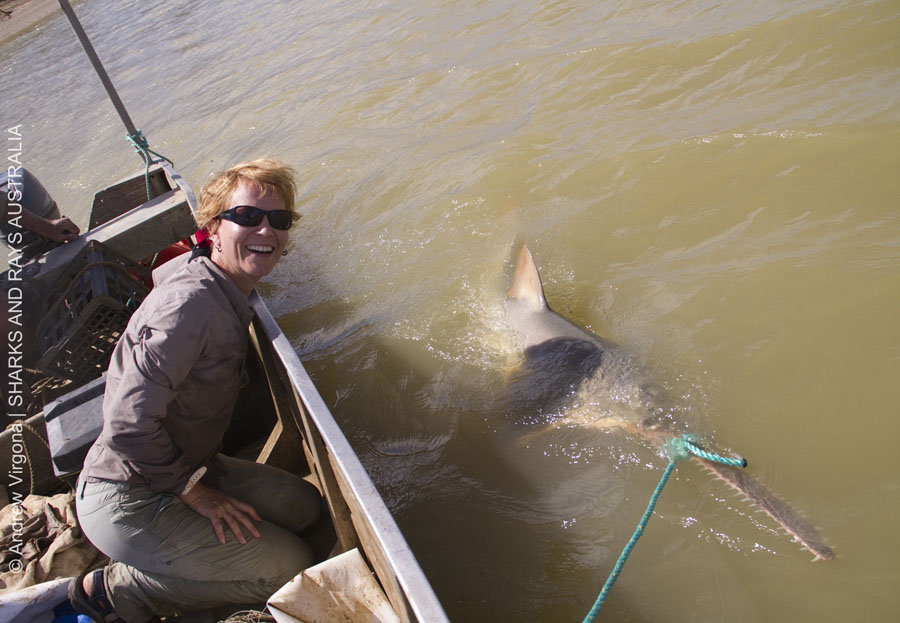
Our philosophy at SARA is that if we do not involve locals, then conservation won’t stand a chance in the long term. And excitedly, our work with Indigenous Ranger groups is expanding. In early 2018 I had the pleasure, for a joint project with the University of Queensland, funded by Rio Tinto Aluminium, to introduce all of the Mapoon Land and Sea Rangers to sawfish research. After a day of inductions, we spent close to a week sampling for sawfish. We did not catch a sawfish, but the community involvement that this expedition has created, assures me that sawfish are in good hands in this region. A community forum was held and many people told me that they had no idea how endangered sawfish were. When I returned to Old Mapoon later that year, some locals told me that they now release sawfish alive if they catch one. Later on in the year, the dedication of these Indigenous rangers enabled our collaborators from UQ to tag four juvenile green sawfish near Mapoon.
The Kowanyama Land and Sea Rangers joined us in the field again this year, and helped us tag and release a juvenile bull shark. The expedition was a dream come true, and also some of the hardest fieldwork I have ever done. After several days of sampling (=getting up at 2 in the morning, sampling, nap, and sampling again until late at night), and several tags detaching early, we ended up actively tracking a juvenile sawfish for 30 hr, followed by 11 hrs of sleep. Happy sleep, I may add. You can read more about this expedition here.
Next year we will run the first joint expedition with the Laura Land and Sea Rangers, who have been very keen to work with us since 2016. Their country is nothing short of spectacular, and probably contains the highest density of sawfish rock artin Australia, which may even be a reflection of historic abundances?! How much these hard working rangers care about sawfish is already visible in their detailed submissions, where TO’s (Traditional Owners of the Land) make sure they note things like the shape of the caudal fin as well as the teeth of a sawfish before releasing it safely.
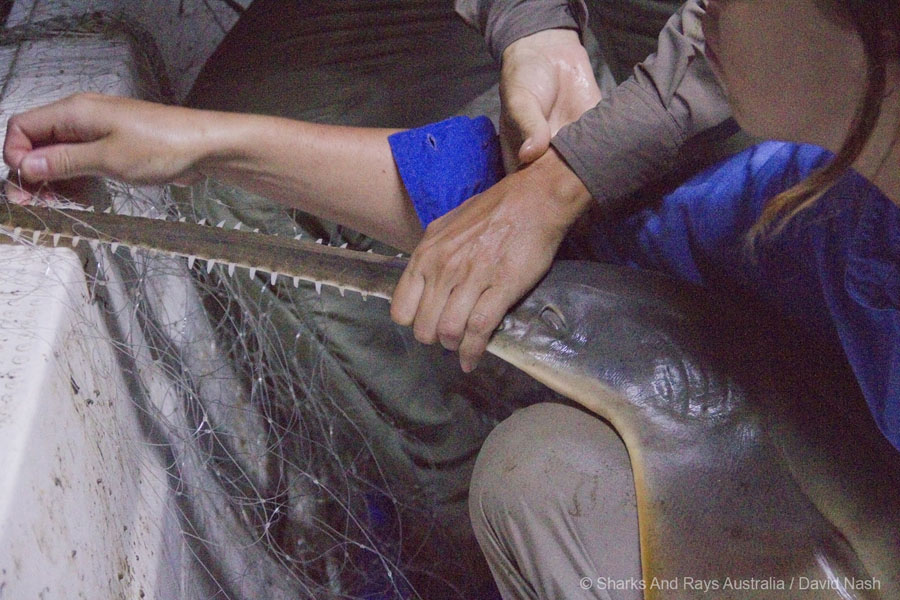
After years of personally working with a handful of commercial fishers, this part of our work is now expanding as well. The larger connection got kicked off in 2016, when I gave a talk at the annual meeting of the Gulf Fisher Associationin Karumba. With the aid of a grant from the Shark Conservation Fund we are currently testing different sawfish release methods. These include a hand tool that a small group of fishers is using and that could make all the difference. Next year, we will be holding several sawfish release workshops, with the aim to find out which methods work best for the different fishers, with the aim of making these methods available to all of them. Currently there are 3 workshops planned for 2019, but this number might increase.
There are loud voices in the conservation sector wanting to phase out gill net fisheries in Queensland. The WWF for example, has bought fishing licences from commercial fishers and laid them dormant. While the replacement of destructive methods with less harmful methods needs to continue globally, we also need to find ways of making gillnet fisheries less harmful for as long as they continue. As a first world nation, Australia has a responsibility in this. Shutting down our own fisheries means exporting our problems, and importing fish from developing nations, where gillnets are still the predominant fishing gear, simply cannot be the solution. When considering buying back licences and thus shutting down gill net fisheries in the Gulf of Carpentaria, it is also important to consider what effect this could have. The whole of Queensland’s coast of the Gulf of Carpentaria, which measures around 1200 km is currently patrolled by four Fisheries Officers from QDAF. If the existing fisheries within this area were shut down, it would be an open invitation for illegal fishing, which cannot be regulated or even assessed with the current methods/budget.
In 2018 we finally received the first ever support from the Queensland Government, through an Engaging Science Grant. This funding allowed us to create a sawfish event at the Cairns Museum, finalize our Food Web Game and talk to around 260 school kids in Far North Queensland and the Cape York Region, including during National Science Week. Now, this number appears vanishingly small compared to what our collaborators from Sharks4Kids are doing (We love their work and that they joined us on our school tour!), but most of the kids we spoke with, and played our food web game with, were Indigenous and had seen a sawfish in the wild, which is super exciting. The Normanton State School was so inspired that their kids will do a project on the life cycle of freshwater sawfish next term. We cannot wait to see the results! You can read more about the school visits here.
With all the data collection going on at SARA, data analysis and publication is becoming an important topic. Mid 2018 we were lucky enough to welcome Grace McNicholas, a MSc student from the University of York in Cairns. Grace spent a great deal of time working on our database and analysing some of our data, and even joined us in the field. She has since returned home and is working on the first paper to come out of our field data.
In late 2018 we also welcomed Jess Hudgins, a MSc/PhD candidate from Heriot-Watt University from Scotland, who is trying to get a grip on historic and current sawfish distributions in Queensland and maybe even Australia. As her project is kicking off, you can find her on the SARA Facebook page through her #ThrowbackThursday posts on historic sawfish captures. Her data analysis already sheds light on the historic perceptions of these animals, which likely contributed to their decline.
In August 2018, we also welcomed Annmarie Fearing, a MSc student from the lab of Dr Nicole Phillips from the University of Mississippi in Cairns. An event in the Cairns Museum during National Science Week kicked off SARA’s involvement in the collection of historic DNA from sawfish rostra. Annmarie’s analysis if these DNA samples will shed light on when sawfish populations decreased in genetic diversity globally. You can read their latest project updates here.
We are now doing eDNA! In 2018, we finally commenced our collaboration with Madie Cooper and Colin Simpfendorfer from JCU Townsville, to collect environmental DNA of sawfish. Every organism swimming in water can be detected through the DNA it gives off. This method is in its infancy, but it can only get more detailed and so we are very excited to be helping with sample collection.
In Queensland, sawfish are protected under the Fisheries Act of 1994, which also makes the possession of sawfish body parts without a permit illegal. Because of this, some people decided to donate not only DNA samples but whole saws to us. In 2019 SARA will start an initiative that will see these saws being lent to other institutions (tourist info centres, local museums, etc), without the need for them to get a permit. We intend to create displays with the saws informing people of the status of sawfish and where to report them. If you have any experience in creating something like this or know how we could fund it, please get in touch!
Lastly we would like to thank Julia Constance, who is now looking after our Instagram. She is doing an awesome job and we could not do without her!
In order to run our fieldwork, and maintain our presence in the field, which appears to make a large difference for sawfish in Queensland, we require Volunteer Field Assistants to join us. Currently the numbers of people joining us are small, which is likely due to us not reaching enough people. If you have ideas for how we can reach more people, get in touch! If you are aware of groups where we can post about our expedition openings or if you can think of other ways of reaching the right people, please let us know. Every single person makes a difference.
I would also like to thank our research supporters, including the Save Our Seas Foundation, the Shark Conservation Fund and starting in 2019, Seaworld Australia. Our local supporters in Cairns are also very important to us, as we know that our car, boat and trailer are in good hands. Thank you Aussie Marine, Warpac Trailers and KW Auto!!
A quick outlook for 2019:
- Our stable isotope project is slowly moving forward, and the first samples have been analysed. The project still requires a dedicated student for it!
- We have heaps of other projects listed online, go check them out!
- In 2019 we will be expanding our work to the east coast of Queensland (permit pending). As sawfish populations have never been assessed in the Great Barrier Reef Marine Park, this work surely is important.
So stay tuned, join our newsletter and find us on social media! @SharksAndRaysAU